
A customer lands on your site with a problem. Maybe they need a roofer, plumber, concrete contractor, landscaper, HVAC company, painter, electrician, or industrial service provider. They are not there to admire design trends.
They want to know three things.
Can you help?
Do you serve my area?
Can I trust you enough to contact you?
If your website does not answer those quickly, the lead can disappear.
Visibility Marketing builds custom websites for Edmonton trades and service businesses that need clearer pages, stronger local positioning, better quote paths, and a site that feels like the real company behind the work.
dmonton businesses need websites that make them look capable before a customer ever calls. A strong website should explain what you do, where you work, what kind of jobs you handle, and why someone should choose you over the next company in the search results.
That sounds simple.
A lot of websites still miss it.
They start with vague copy. “Quality service you can trust.” “Your local experts.” “Committed to excellence.” Fine words, but they do not tell the customer much.
A good trades website needs to be more useful than that.
It should show the real work. The service areas. The job types. The finished projects. The process. The quote path. The proof that you are active and ready to help.
Pretty helps.
Clear wins.
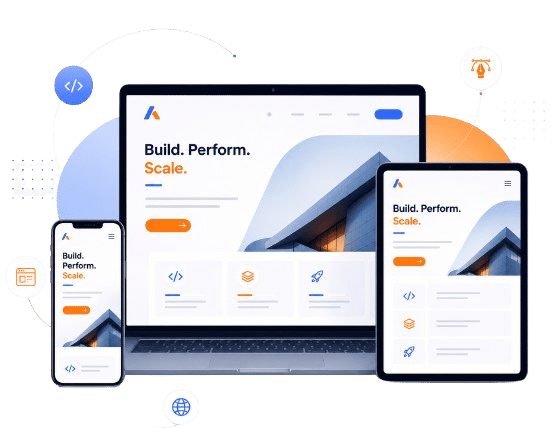

Most contractor websites look and sound the same.
Big hero image. Generic headline. Three service boxes. A paragraph about quality. A contact button. Done.
That might be enough to exist online.
It is not enough to stand out.
A custom website should feel like your business. A drywall company should not sound like a landscaping company. A millwright contractor should not sound like a roofer. A plumber running emergency calls should not have the same page structure as a custom home builder booking large projects.
Different work needs different pages.
Different buyers need different messages.
That is why custom development matters. The site should be shaped around your services, your market, your customers, your service areas, and how people actually decide to contact you.
A trades website needs to guide people toward action without making the page feel desperate.
That means the quote path should be clear.
Phone number easy to find.
Contact buttons in the right places.
Forms that ask useful questions.
Service pages that explain the work.
Location pages that make coverage clear.
Proof that supports the decision.
No one should have to hunt for how to reach you.
And no one should land on a service page and still wonder if you handle the job.
For some businesses, the best action is a phone call. For others, it is a quote form, site visit request, booking form, or consultation. The website should support that natural next step.
Not force every visitor through the same awkward funnel.
A custom website gives your services room to breathe. That matters because most trades businesses do more than one thing, and each service may attract a different type of customer.
A concrete company might need separate pages for driveways, garage pads, patios, sidewalks, and commercial flatwork. A roofing company may need roof repair, replacement, inspections, emergency leaks, and storm damage pages. A plumber may need drain cleaning, sewer repair, sump pumps, water lines, and emergency plumbing.
Those should not all be buried in one paragraph.
Customers search for specific problems.
Your website should meet them there.
The more clearly each service is explained, the easier it is for customers and search engines to understand what your business offers.
If your business serves Edmonton and nearby communities, your website should show that clearly without stuffing city names everywhere.
A proper custom site can support service-area content in a way that feels smooth. Edmonton can be the main hub, with nearby locations like St. Albert, Sherwood Park, Spruce Grove, Stony Plain, Leduc, Beaumont, and Fort Saskatchewan worked in naturally where they make sense.
Some locations may need their own pages.
Some may only need to be mentioned as part of your service area.
The right setup depends on the business, the competition, the distance, and whether you actually want more work from that area.
No fake coverage.
No copied city pages with one name swapped out.
Just a cleaner local structure built around the places you actually serve.
A website for a trades business does not need to win an art award.
It needs to build confidence.
The design should make your work easy to understand. Real photos should be used where possible. Services should be easy to scan. Calls to action should be clear. Mobile layout should be tight. Pages should load properly. The site should not make people pinch, zoom, wait, or guess.
Most customers are checking on their phone.
That matters.
If the mobile version is clunky, the desktop version does not save you. A customer standing in a flooded basement, sitting in a truck, or comparing contractors after work is not going to fight with a broken layout.
They will leave.
Good design removes friction.
A custom website should not only look good. It should work properly.
That means clean structure, fast-loading pages, responsive layouts, proper heading hierarchy, clear navigation, optimized images, working forms, basic tracking, and a setup that can grow with the business.
Technical issues create trust issues.
A form that does not submit. A page that loads slowly. A phone number that is hard to tap. Images that break. Service pages that are not linked properly. A site that looks fine on a laptop but falls apart on mobile.
These things cost leads.
Sometimes quietly.
A strong website should feel stable from the front end and be organized behind the scenes.
A custom website is not just code and design. The content matters just as much.
A clean layout cannot fix weak messaging.
If the page does not explain the service, show trust, answer customer questions, or make the next step clear, the design is doing all the heavy lifting. That usually does not end well.
Content and development should be planned together.
The page layout should support the message. The headings should guide the reader. The service sections should match real buying questions. The contact points should appear where people naturally need them.
That is how a website feels smooth instead of stitched together.
Most underperforming trades websites have the same issues.
Thin service pages. Generic copy. Weak mobile layout. Slow load times. No clear quote path. Poor project proof. Confusing navigation. Missing location structure. Old photos. Broken forms. No tracking. Too much design and not enough clarity.
Sometimes the business itself is strong.
The website just does not show it.
That is frustrating, but fixable.
A better website should close the gap between the quality of the work and the way the business appears online.
Grow your drywall company with SEO, website design, and local marketing built to attract builders, homeowners, and commercial project leads.
Get more concrete project inquiries with a stronger online presence, optimized service pages, and local SEO designed for high-intent searches.
Turn your painting website into a lead-generating asset with local SEO, conversion-focused copy, and pages built to rank for your best services.
Build trust before the first call with a professional website, strong project positioning, and SEO that helps clients find your contracting services.
Show up when property owners search for roofing help. We help roofers improve visibility, build trust, and generate more local leads.
From emergency repair searches to installation leads, we help HVAC companies improve search rankings and convert more local traffic.
Get found for urgent plumbing searches and planned service needs with SEO and website strategies built for local service businesses.
Help homeowners, builders, and commercial clients find your electrical services with a stronger website, local SEO, and clear conversion paths.
Showcase craftsmanship, build credibility, and attract better-fit custom home clients with a premium website and search strategy.
Generate more local landscaping inquiries with service pages, project-focused content, and SEO built around seasonal and high-value searches.
Operator: Running earthmoving machinery like excavators, loaders, bulldozers, and graders for infrastructure development.
Installing, troubleshooting, and maintaining complex automated machinery inside manufacturing plants and refineries.
You can expect a custom website development process built around your services, your customers, your service areas, and your quote goals.
We look at what your current website is missing, what customers need to understand, what pages should exist, how the site should be structured, and how people should move from first visit to contact.
Then we build around that.
That may include page planning, custom layout design, service page structure, location page setup, mobile optimization, form setup, call-to-action placement, content support, technical cleanup, and launch preparation.
No template shoved into place just because it is fast.
No design that looks good but makes the customer work too hard.
No website that gets launched and immediately feels impossible to update.
Just a clean, practical site that makes your business easier to understand, easier to trust, and easier to contact.
Yes. We specialize exclusively in trades and construction businesses to deliver more effective, industry-specific results.
No. Our agreements are month-to-month, with no contracts longer than 30 days.
Most clients start seeing measurable improvements within 60–90 days, depending on competition and current positioning.
Our primary focus is Edmonton and surrounding areas, but we may work with select Canadian trades businesses.
We’re trades-only, locally focused, and results-driven — no generic strategies or outsourced account management.
Yes. We design high-converting websites specifically for trades businesses.